And then vacation got busy and my reading dwindled...
Oops. I should have known. I did manage to read five books during break:
Behemoth by Scott Westerfeld
Escape! The Story of the Great Houdini by Paul Fleischman
Once Upon a Time in the North by Philip Pullman (audiobook)
White Cat by Holly Black (audiobook)
We Have Always Lived in the Castle by Shirley Jackson
I really enjoyed all of them. During break I started three others:
My Family and Other Animals by Gerald Durrell
Moominpapa at Sea by Tove Jansson
Does Anybody Have a Problem with That? by Bill Maher
While I've still not completed any of those I did take a brief break and read Ender's Game for my RRVWP book club and really enjoyed it. I am hopeful that I'll get back to these three again soon since I am also determined to read Olive Kitteridge by Elizabeth Strout in the next few days before the Great Reads Book Club at the library next week.
Already January is half done and I managed to pick up another fine stack of tantalizing books when I was at Half Price Books in the Twin Cities over Christmas break.
Showing posts with label authors. Show all posts
Showing posts with label authors. Show all posts
Wednesday, January 12, 2011


Saturday, December 11, 2010


Sunday, December 05, 2010
To Judge a Book By Its Cover

In recent years I've been amassing a collection of Bond books with a particular set of covers I so love, those put out by Penguin in the early 2000's with cover art by Roseanne Serra and Richie Fahey. I have ten of the 15 books (if you count the short story collection Quantum of Solace). I try to pick these up "used" when I'm at Half Price Books or some other reasonably priced book joint. Still on my must-have list are these: You Only Live Twice, Quantum of Solace, The Man With the Golden Gun, Diamonds are Forever, and From Russia With Love.
 Today I discovered another edition that I feel I MUST own. Despite the fact that I've seen all the films and am a huge fan, I've only actually READ two books by Ian Fleming: Goldfinger and Chitty Chitty Bang Bang. Still, the new Penguin cover art blows me away. Good job, Michael Gilette. Take a look.
 If you're curious about the order of the books. Apparently one ought to read them in the proper order and little attention has been paid to this by book publishers in the past. Not so, this time with the new Penguin editions. Seriously. Aren't these just yummy?
Saturday, August 28, 2010
I Admire the Enthusiasm.
About a week ago I heard a Ray Bradbury tribute video that both stunned me and made me laugh out loud. I am most certain it crosses several lines and then tap dances with glee on the other side. While I won't be posting the video here, it's certainly something you can search out when you aren't at work or in the presence of the easily offended or young ears of the world. Here's a link to an article that describes and discusses it better than I do.
The Ray Bradbury Tribute I Never Expected to See posted by David Barnett on the book blog page of The Guardian.
The Ray Bradbury Tribute I Never Expected to See posted by David Barnett on the book blog page of The Guardian.
Tuesday, May 11, 2010
Oliver Jeffers -- Illustrator, Author Extraordinaire
 Oliver Jeffers' work is some of my favorite among childrens book illustrators and really among any artists. There is a charm that is difficult for me to define. I will just say, whether intentional or not, he's part of the Wes Anderson, Dave Eggers, and Jean-Pierre Jeunet club that hangs out in my brain. Here's a link to his official site.
Following a parade of images is a video in which he describes who he is and where he came from (in a way that only Oliver Jeffers can!) and his creative process. It's long but fascinating.


2010/04 Oliver Jeffers from CreativeMornings on Vimeo.
Sunday, April 04, 2010
Bright Star -- a poetic movie

In honor of poetry month, I had to make a point of watching Bright Star, a film about the relationship between 19th Century poet John Keats and Fanny Brawne. Lord, this was depressing. It was a beautiful movie and it got me digging into their stories after I watched the film, but ultimately I wasn't blown away or quick to recommend it to others.
Tuesday, March 23, 2010
UND Writers Conference 2010
 Deena Larsen 4:00 pm Reading
at UND Writers Conference
Our RRVWP featured author was Deena Larsen and she and her partner were kind enough to join us for dinner at Eagle's Crest after her 4:00 reading. She talked about links and hypertext poetry and secrets. She used grad students holding images and phrases to demonstrate the power and versatility of links. I get it, I think. I'm just more of a straight forward boring girl. Cecelia Condit and husband
 Cecelia Condit and husband
 Deena Larsen and Nick Montfort
In addition to Deena we also got to chat with Nick Montfort and Cecelia Condit.
There were just enough of us that there seemed to be three-five conversations going at once and I was caught up mostly in the Nick Montfort Q & A. I fear we scared him with our rapid fire questions, the poor guy. Still it was fascinating learning about Implementation, his sticker novel (a novel in approx. 240 sticker installments spread all over the world), and discovering he'd also read The Diamond Age by Neal Stephenson and without missing a beat could refer to bits of the bizarro technology in that world. Despite the fact that I'd not read as much of their works prior to our dinner, it was still a fascinating discussion.
 Following dinner, I drove back to campus for Art Spiegelman's presidential address. It was a wild ride of images, ideas, and history of comics. Jack Weinstein interviewed Spiegelman.
 I still need to decipher my notes, but here were a few of the things Spiegelman said:
Regarding Maus, he wanted to write a comic book that readers would need a bookmark for. He didn't set out to write a "graphic novel." It seems graphic novels have more respectability. He's managed to create "art." Spiegelman says, "It's a bit like thinking you are a "hooker" and finding out that you're a "lady of the night." After hearing he's considered the father of the graphic novel Spiegelman says, "I'm demanding a blood test."
Sunday, January 24, 2010
More Mrs. Piggle Wiggle
 Remember Mrs. Piggle Wiggle, her upside down house, cures for naughty children, and her super long hair? I loved this series of books by Betty MacDonald. Laurel Snyder has written a new Mrs. Piggle Wiggle short story that made me smile! Ah, yes, times have changed.
Saturday, January 23, 2010
A Trio of Atwood Poems
A few days ago my friend Pattie requested poetry recommendations. Margaret Atwood came to mind but I couldn't think of one particular poem to point out. I couldn't decide which was the best to showcase the wonder of this author. She's a wee bit creepy in all these poems. A bit intense. One of my favorites ("Variation on the word sleep") is a little stalker-ish. "Siren Song" is terrific, but enjoyed most when one understands the allusion to The Odyssey. I reprinted all three here just for some poetry fun today!
Spelling
by Margaret Atwood
My daughter plays on the floor
with plastic letters,
red, blue & hard yellow,
learning how to spell,
spelling,
how to make spells.
I wonder how many women
denied themselves daughters,
closed themselves in rooms,
drew the curtains
so they could mainline words.
A child is not a poem,
a poem is not a child.
there is no either/or.
However.
I return to the story
of the woman caught in the war
& in labour, her thighs tied
together by the enemy
so she could not give birth.
Ancestress: the burning witch,
her mouth covered by leather
to strangle words.
A word after a word
after a word is power.
At the point where language falls away
from the hot bones, at the point
where the rock breaks open and darkness
flows out of it like blood, at
the melting point of granite
when the bones know
they are hollow & the word
splits & doubles & speaks
the truth & the body
itself becomes a mouth.
This is a metaphor.
How do you learn to spell?
Blood, sky & the sun,
your own name first,
your first naming, your first name,
your first word.
---------------------------------------
Variation On The Word Sleep
by Margaret Atwood
I would like to watch you sleeping,
which may not happen.
I would like to watch you,
sleeping. I would like to sleep
with you, to enter
your sleep as its smooth dark wave
slides over my head
and walk with you through that lucent
wavering forest of bluegreen leaves
with its watery sun & three moons
towards the cave where you must descend,
towards your worst fear
I would like to give you the silver
branch, the small white flower, the one
word that will protect you
from the grief at the center
of your dream, from the grief
at the center I would like to follow
you up the long stairway
again & become
the boat that would row you back
carefully, a flame
in two cupped hands
to where your body lies
beside me, and as you enter
it as easily as breathing in
I would like to be the air
that inhabits you for a moment
only. I would like to be that unnoticed
& that necessary.
---------------------------------
Siren Song
by Margaret Atwood
This is the one song everyone
would like to learn: the song
that is irresistible:
the song that forces men
to leap overboard in squadrons
even though they see beached skulls
the song nobody knows
because anyone who had heard it
is dead, and the others can’t remember.
Shall I tell you the secret
and if I do, will you get me
out of this bird suit?
I don’t enjoy it here
squatting on this island
looking picturesque and mythical
with these two feathery maniacs,
I don’t enjoy singing
this trio, fatal and valuable.
I will tell the secret to you,
to you, only to you.
Come closer. This song
is a cry for help: Help me!
Only you, only you can,
you are unique
at last. Alas
it is a boring song
but it works every time.
Spelling
by Margaret Atwood
My daughter plays on the floor
with plastic letters,
red, blue & hard yellow,
learning how to spell,
spelling,
how to make spells.
I wonder how many women
denied themselves daughters,
closed themselves in rooms,
drew the curtains
so they could mainline words.
A child is not a poem,
a poem is not a child.
there is no either/or.
However.
I return to the story
of the woman caught in the war
& in labour, her thighs tied
together by the enemy
so she could not give birth.
Ancestress: the burning witch,
her mouth covered by leather
to strangle words.
A word after a word
after a word is power.
At the point where language falls away
from the hot bones, at the point
where the rock breaks open and darkness
flows out of it like blood, at
the melting point of granite
when the bones know
they are hollow & the word
splits & doubles & speaks
the truth & the body
itself becomes a mouth.
This is a metaphor.
How do you learn to spell?
Blood, sky & the sun,
your own name first,
your first naming, your first name,
your first word.
---------------------------------------
Variation On The Word Sleep
by Margaret Atwood
I would like to watch you sleeping,
which may not happen.
I would like to watch you,
sleeping. I would like to sleep
with you, to enter
your sleep as its smooth dark wave
slides over my head
and walk with you through that lucent
wavering forest of bluegreen leaves
with its watery sun & three moons
towards the cave where you must descend,
towards your worst fear
I would like to give you the silver
branch, the small white flower, the one
word that will protect you
from the grief at the center
of your dream, from the grief
at the center I would like to follow
you up the long stairway
again & become
the boat that would row you back
carefully, a flame
in two cupped hands
to where your body lies
beside me, and as you enter
it as easily as breathing in
I would like to be the air
that inhabits you for a moment
only. I would like to be that unnoticed
& that necessary.
---------------------------------
Siren Song
by Margaret Atwood
This is the one song everyone
would like to learn: the song
that is irresistible:
the song that forces men
to leap overboard in squadrons
even though they see beached skulls
the song nobody knows
because anyone who had heard it
is dead, and the others can’t remember.
Shall I tell you the secret
and if I do, will you get me
out of this bird suit?
I don’t enjoy it here
squatting on this island
looking picturesque and mythical
with these two feathery maniacs,
I don’t enjoy singing
this trio, fatal and valuable.
I will tell the secret to you,
to you, only to you.
Come closer. This song
is a cry for help: Help me!
Only you, only you can,
you are unique
at last. Alas
it is a boring song
but it works every time.
Friday, January 22, 2010
All the World.

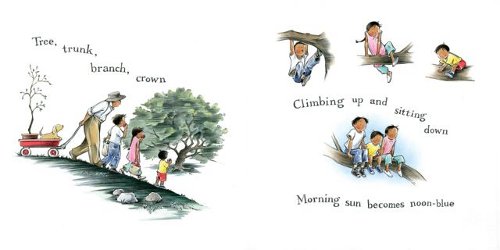
All the World by Liz Garton Scanlon,
Illustrated by Marla Frazee
I picked up a copy of Scanlon/Frazee's book at the library after seeing a mention online and I wasn't disappointed. This children's book offers a beautiful message of celebration for all that is good in the world and lovely illustrations. I have loved and own several books illustrated by Marla Frazee (The Seven Silly Eaters, Santa Claus: The World's Number One Toy Expert) and it is always the artwork in a picture book that sucks me in. This one is no exception. It's no wonder that All the World is one of the Caldecott Honor books for 2009.

Check out a GREAT post on Marla Frazee over at Seven Impossible Things Before Breakfast.
Illustrated by Marla Frazee
"Rock, stone, pebble, sand
Body, shoulder, arm, hand
A moat to dig,
a shell to keep
All the world is wide and deep."
Body, shoulder, arm, hand
A moat to dig,
a shell to keep
All the world is wide and deep."
I picked up a copy of Scanlon/Frazee's book at the library after seeing a mention online and I wasn't disappointed. This children's book offers a beautiful message of celebration for all that is good in the world and lovely illustrations. I have loved and own several books illustrated by Marla Frazee (The Seven Silly Eaters, Santa Claus: The World's Number One Toy Expert) and it is always the artwork in a picture book that sucks me in. This one is no exception. It's no wonder that All the World is one of the Caldecott Honor books for 2009.
Check out a GREAT post on Marla Frazee over at Seven Impossible Things Before Breakfast.
Saturday, July 04, 2009
Happy Mini Donut Day!


Errr... I mean, 4th of July. Sometimes I forget the reason behind the season and just start to celebrate deep fried festival foods --mini-donuts, stuff on sticks, Indian tacos, and beer gardens.
I just got back from a quick trip around the downtown food fest -- oops, there I go again. The inflatable kid bouncy things were deflating and making way for lawn chairs and families getting an early jump on prime fireworks watching spots. What the heck? Is someone REALLY going to stake their claim four hours early? Oh well. Not everyone can watch the fireworks from his/her bedroom window.
My mom, my uncle, and I strolled the town square listening to live music and watching kids get caricatured and folks get henna tattooed. Everyone and his dog was out on the town --literally--there were a lot of dogs to be seen. I thought about taking pictures just to show the diversity of pooch, but I was afraid of appearing strange, so I took pics of food instead!
On a more serious note, many folks get patriotic on Independence Day --they don the "team colors" and wave the flag, singing songs of praise for one's country. It all smacks of a giant pep rally. I see nothing wrong with that except that too quickly it's all forgotten. Like a Christian who makes it to church for the holiday services a few times a year, too many of us are fair weather-Americans. Patriotic, duty-bound citizens when it serves us, when it's popular. Too many of us curse the government, the economy, in one moment and do nothing to change the things we can with all our other moments. A Chinese proverb says, "It is better to light one candle than to curse the darkness." Don't just celebrate our freedoms with bottle rockets and cold beer--honor your country's independence with your votes and by getting involved in your communities.
What do we mean by patriotism in the context of our times? I venture to suggest that what we mean is a sense of national responsibility ... a patriotism which is not short, frenzied outbursts of emotion, but the tranquil and steady dedication of a lifetime. --Adlai Stevenson
The true test of the American ideal is whether we're able to recognize our failings and then rise together to meet the challenges of our time. Whether we allow ourselves to be shaped by events and history, or whether we act to shape them. --Barack Obama
The notion that a radical is one who hates his country is naïve and usually idiotic. He is, more likely, one who likes his country more than the rest of us, and is thus more disturbed than the rest of us when he sees it debauched. He is not a bad citizen turning to crime; he is a good citizen driven to despair. --H.L. Mencken
The government is merely a servant -- merely a temporary servant; it cannot be its prerogative to determine what is right and what is wrong, and decide who is a patriot and who isn't. Its function is to obey orders, not originate them. -- Mark Twain
Happy Fourth of July!
Tuesday, June 30, 2009
Kurt Vonnegut--On Writing
Having just finished reading Slaughterhouse Five for the very first time, I felt it necessary to dig into Vonnegut's life and try to make some sense of what I'd read. I'll say more about the novel in my monthly "in review" post coming soon... for now I'll leave you with this:
In his book Bagombo Snuff Box: Uncollected Short Fiction, Vonnegut listed eight rules for writing a short story:
- Use the time of a total stranger in such a way that he or she will not feel the time was wasted.
- Give the reader at least one character he or she can root for.
- Every character should want something, even if it is only a glass of water.
- Every sentence must do one of two things—reveal character or advance the action.
- Start as close to the end as possible.
- Be a Sadist. No matter how sweet and innocent your leading characters, make awful things happen to them—in order that the reader may see what they are made of.
- Write to please just one person. If you open a window and make love to the world, so to speak, your story will get pneumonia.
- Give your readers as much information as possible as soon as possible. To hell with suspense. Readers should have such complete understanding of what is going on, where and why, that they could finish the story themselves, should cockroaches eat the last few pages.
Friday, June 26, 2009
The Importance of Oscar Wilde
 "This wallpaper is dreadful, one of us will have to go." Those are rumored to be Oscar Wilde's last words. Even to the end he was a man of wit. Here are a few other words of wit and wisdom from one of the greats.
- "I am so clever that sometimes I don't understand a single word of what I am saying."
- "Always forgive your enemies; nothing annoys them so much."
- "We are all in the gutter, but some of us are looking at the stars."
- "Be Yourself; everyone else is already taken."
- "Anyone who lives within their means suffers from a lack of imagination."
- "You can never be overdressed or overeducated."
- "I am not young enough to know everything."
- "A cynic is a man who knows the price of everything, and the value of nothing."
- "A good friend will always stab you in the front."
- "I never travel without my diary. One must always have something sensational to read on the train."
- "Man is least himself when he talks in his own person. Give him a mask, and he will tell you the truth."
- "I can resist anything, except temptation."
- "Every saint has a past, and every sinner has a future."
- "Selfishness is not living as one wishes to live, it is asking others to live as one wishes to live."
- "I have the simplest tastes. I am always satisfied with the best."
- "A man's face is his autobiography. A woman's face is her work of fiction."
- "In this world there are only two tragedies. One is not getting what one wants, and the other is getting it."
- "There are only two kinds of people who are really fascinating: people who know absolutely everything, and people who know absolutely nothing."
- "Misfortunes one can endure--they come from outside, they are accidents. But to suffer for one's own faults--ah!--there is the sting of life."
The 2002 film with Rupert Everett and Colin Firth is most excellent, as well. While it does stray some from the order of events in the play, the director does a fine job of capturing the spirit of Wilde even adding some nice, tattooed touches. :) Read it, watch it--preferably in that order--you won't be disappointed.

Tuesday, June 16, 2009
Summer School Shakespeare Fun!


A Midsummer Night's Dream and Much Ado About Nothing are two of my favorite Shakespeares. This year in summer school I opted for some comedy rather than the typical Macbeth, I usually teach. Though I've seen both of these before I was as entertained as the kids. Kevin Kline's performance in A Midsummer Night's Dream is terrific and I have new love for fair Hermia, since I now know Anna Friel from the TV series Pushing Daisies. This is a most excellent version of the play on all counts.
Kenneth Branaugh and Emma Thompson really shine as Beatrice and Benedick, a pair of marriage-scorning rivals in Much Ado About Nothing. This 1993 film, showcases an all-star cast with Kate Beckinsale as Hero and Robert Sean Leonard as Claudio; Denzel Washington as Don Pedro and Keanu Reeves as his bastard brother Don John. Another show stealer is Michael Keaton in the role of Dogberry.
Keaton is a former Batman star, as is Christian Bale in Midsummer Night's Dream--while two Batmen are among the cast, so is a former Catwoman-- Michelle Pfeiffer. I just found this to be an irrelevant, sure, but somewhat amusing bit of trivia.
There is little I can say to recommend these films other than to say the settings are divine, the acting superb, Shakespeare's play's withstood the test of time and the director does a great job in bringing it to life. Rent them both when you are in the mood for a bit of good Shakespeare fun.
Wednesday, May 06, 2009


Tuesday, May 05, 2009
Tuesday Afternoon -- Vocabulary
Learning Words Inside and Out
by Doug Fisher and Nancy Frey
The powerpoint for this session can be found on their website under resources -- it's called ira_vocab-blog. And it was excellent, or the presentation was. An action packed hour, I left with my brain heavy with ideas. Overwhelmed thinking about what I need to do with vocabulary in my classroom, in my school.
One of the things that left a big impression on me was a video clip they played of a history teacher doing a think aloud with his students showing them how to navigate the text and unfamiliar words in their book. I thought it was entertaining AND helpful. The clip for this is on the Heinemann site and the particular video clip is in chapter three "Making it Transparent."
Beacause I teach at an alternative school, I am constantly struggling with how to deliver mini-lessons and directions in a consistent manner to ALL students especially when I have new students in my classroom every Monday and Wednesday, with our rolling enrollment. However, it occurs to me that I could record myself doing a think aloud activity, for example and I could have it available on a class website OR on a disc for students to watch at various points in the course. I could do this same technique with key lessons that I want all students to hear and could also do live mini-lessons that supplement those too.
But I digress.
This vocab session was most excellent. I'm not even sure I can sum it up.
Fisher began with an anecdote about his experience taking a college class on the brain. He wanted to drop the class after his first reading assignment but pride prevented it. He showed us a sample of the textbook and it was crazy hard. He challenged us to use our comprehension strategies on the text... try to visualize what we were reading... how about make a connection... an inference? Here's a prediction. "I am not going to pass this class."
No amount of comprehension strategies can help if the student lacks the vocabulary and background knowledge. And vocabulary IS background knowledge. If you have a word for it, that shows you understand it.
In order to understand his brain textbook, Doug bought other books in an effort to build up his background knowledge. "Clinical Neuroanatomy Made Ridiculously Simple, the Interactive Edition." He watched over 100 you tube videos , watched a PBS special on the secret life of the brain, and he talked with peers. He took a wig stand, painted a brain on it, and used push pins to try to learn the parts of the brain.
You can't learn from books you can't read. But you CAN learn. He never did read the assigned book but he read widely from other resources and he relied on strategies.
Intentional Vocabulary Initiative -- 5 Priorities
1. Make it Intentional through word selection and intentional instruction
2. Make it Transparent through teacher modeling of word-solving and word learning
3. Make it Usable with collaborative learning
4. Make it Personal by fostering student ownership
5. Make it a Priority with school wide practices
Now to break that down:
1. Making it Intentional
Begin by assessing where you are as a school. There's a rubric for this on the Heinemann site.
Use gradual release of responsibility:
I do it (focused lesson), We do it (guided instruction), You do it together(collaboratively), You do it alone (independent practice)
But what words do we choose?
Consider the influence of background knowledge.
Types of vocab
Questions for selecting Vocab
1. representative -- Is it critical to understanding?
2. repeatable -- Will it be used again?
3. transportable -- Is it needed for discussiosn or writing?
4. contextual analysis -- Can they use context to figure it out?
5. structural analysis --Can they use structure?
6. cognitive load --Have I exceeded the number they can learn?
2. Make it Transparent -- Modeling
Show students how WE solve for unknown words. Don' t just tell them what words mean. Show students how to look inside (morphology and structure) and outside (context clues and resources) words (this is the point at which they showed us the think aloud video)
What to model?
Context Clues
3. Make it Usable -- Collaborate with Peers
4. Make it Personal: Individual Activities
 This section showed a variety of ways teachers could do individual assignments and this chart is just one example.
5. Make it a Priority: Creating a Schoolwide Focus
One emphasis was simply on silent sustained reading. The more kids read, the more words they are exposed to.
Another idea was to do WOW words -- Words of the Week. One school focused on SAT words and grouped their words by affix or derivation and featured five words a week (Fid, Fi: to trust -- affidavit, confidant, defiant, fidelity, infidel) Departments proposed words and they were introduced in English classes. One school's art and technology students made posters to hang around the school. I loved these and could really see how they'd attract attention, combine skills for the technology students and also support the learning of the words. Here are a few examples:


by Doug Fisher and Nancy Frey
The powerpoint for this session can be found on their website under resources -- it's called ira_vocab-blog. And it was excellent, or the presentation was. An action packed hour, I left with my brain heavy with ideas. Overwhelmed thinking about what I need to do with vocabulary in my classroom, in my school.
One of the things that left a big impression on me was a video clip they played of a history teacher doing a think aloud with his students showing them how to navigate the text and unfamiliar words in their book. I thought it was entertaining AND helpful. The clip for this is on the Heinemann site and the particular video clip is in chapter three "Making it Transparent."
Beacause I teach at an alternative school, I am constantly struggling with how to deliver mini-lessons and directions in a consistent manner to ALL students especially when I have new students in my classroom every Monday and Wednesday, with our rolling enrollment. However, it occurs to me that I could record myself doing a think aloud activity, for example and I could have it available on a class website OR on a disc for students to watch at various points in the course. I could do this same technique with key lessons that I want all students to hear and could also do live mini-lessons that supplement those too.
But I digress.
This vocab session was most excellent. I'm not even sure I can sum it up.
Fisher began with an anecdote about his experience taking a college class on the brain. He wanted to drop the class after his first reading assignment but pride prevented it. He showed us a sample of the textbook and it was crazy hard. He challenged us to use our comprehension strategies on the text... try to visualize what we were reading... how about make a connection... an inference? Here's a prediction. "I am not going to pass this class."
No amount of comprehension strategies can help if the student lacks the vocabulary and background knowledge. And vocabulary IS background knowledge. If you have a word for it, that shows you understand it.
In order to understand his brain textbook, Doug bought other books in an effort to build up his background knowledge. "Clinical Neuroanatomy Made Ridiculously Simple, the Interactive Edition." He watched over 100 you tube videos , watched a PBS special on the secret life of the brain, and he talked with peers. He took a wig stand, painted a brain on it, and used push pins to try to learn the parts of the brain.
You can't learn from books you can't read. But you CAN learn. He never did read the assigned book but he read widely from other resources and he relied on strategies.
Intentional Vocabulary Initiative -- 5 Priorities
1. Make it Intentional through word selection and intentional instruction
2. Make it Transparent through teacher modeling of word-solving and word learning
3. Make it Usable with collaborative learning
4. Make it Personal by fostering student ownership
5. Make it a Priority with school wide practices
Now to break that down:
1. Making it Intentional
Begin by assessing where you are as a school. There's a rubric for this on the Heinemann site.
Use gradual release of responsibility:
I do it (focused lesson), We do it (guided instruction), You do it together(collaboratively), You do it alone (independent practice)
But what words do we choose?
Consider the influence of background knowledge.
Types of vocab
- tier 1 general (commonplace; learned from interactions with people)
- tier 2 specialized (change meaning due to context)
- tier 3 technical (specific to discipline)
Questions for selecting Vocab
1. representative -- Is it critical to understanding?
2. repeatable -- Will it be used again?
3. transportable -- Is it needed for discussiosn or writing?
4. contextual analysis -- Can they use context to figure it out?
5. structural analysis --Can they use structure?
6. cognitive load --Have I exceeded the number they can learn?
2. Make it Transparent -- Modeling
Show students how WE solve for unknown words. Don' t just tell them what words mean. Show students how to look inside (morphology and structure) and outside (context clues and resources) words (this is the point at which they showed us the think aloud video)
What to model?
- Comprehension
- Word Solving
- Text Structure
- Text Features
- Context Clues
- Morphology
- Resources
Context Clues
- Definition/Explanation --Access to clean water would ameliorate, and improve upon, living conditions within the village.
- Restatement/Synonym --Access to clean water would ameliorate living conditions within the village such that life would be tolerable for the people who live there.
- Contrast/Antonym --Access to clean water would ameliorate living conditions within the village whereas continued reliance on a polluted river will exacerbate a bad situation.
- Inference/General Context --Access to clean water would ameliorate living conditions within the village. Clean water would make life tolerable as residents could focus on other pressing needs such as finding food and shelter.
- Punctuation-- Access to clean water would ameliorate--make tolerable--living conditions within the village.
3. Make it Usable -- Collaborate with Peers

- Partner and small-group discussions
- Jigsaws
- Student think-alouds
- Reciprocal teaching
- Co-constructed graphic organizers
- Semantic feature analysis
4. Make it Personal: Individual Activities
 This section showed a variety of ways teachers could do individual assignments and this chart is just one example.
5. Make it a Priority: Creating a Schoolwide Focus
One emphasis was simply on silent sustained reading. The more kids read, the more words they are exposed to.
Another idea was to do WOW words -- Words of the Week. One school focused on SAT words and grouped their words by affix or derivation and featured five words a week (Fid, Fi: to trust -- affidavit, confidant, defiant, fidelity, infidel) Departments proposed words and they were introduced in English classes. One school's art and technology students made posters to hang around the school. I loved these and could really see how they'd attract attention, combine skills for the technology students and also support the learning of the words. Here are a few examples:


The Exhibits -- The Authors


Patricia Polacco, a personal favorite,
drew the biggest crowds at Penguin
 Skippyjon Jones at Penguin
He was on hand for pictures!
drew the biggest crowds at Penguin
 Skippyjon Jones at Penguin
He was on hand for pictures!
I got a ton of books signed by wonderful authors: John Green (Looking for Alaska, Paper Towns), Jaime Adoff (Jimi and Me, Names will Never Hurt Me), Elise Broach (Masterpiece, Shakespeare's Secret), Jerry Pallotta (The Ocean Alphabet Book, The Icky Bug Alphabet Book), Paul B. Janeczko (A Poke in the I, A Kick in the Head, A Foot in the Mouth) and more that I'm probably not remembering... Yikes.
The exhibits are great fun when it comes to discovering the latest children's book titles and getting advance reader copies. One of my favorite moments is when Disney Hyperion pressed a free brand new hardcover copy of Percy Jackson and the Last Olympian into my hands. Of course, I bought plenty books too. I think I left the conference with approximately 120 new books & advance reader copies.
Tuesday Morning -- Teaching for Social Responsibility
Books + Inquiry: Teaching for Social Responsibility with Young Adult Literature
Presented by Steven Wolk
He started with homework: Read The Absolutely True Diary of a Part-time Indian by Sherman Alexie. And for the next hour not only did he share some must read titles and how they could be used in the classroom he explored the WHYs of teaching.
Why read?
When we ask students this the response is sometimes what they think we want to hear. Some actually answer "to improve my vocabulary or my fluency." Seriously. I have many answers to that question... to escape, to explore, to relate to others, to understand people who are not like me, to be entertained, to learn about something I didn't know before, to have a shared experience with other readers... there are so many more reasons.
Wolk said too many kids fail to see a valid reason for reading and Cris Tovani, author of I Read it But I Don't Get It reminds us that purpose is everything.
Some purposes for reading our presenter suggested:
"The heart and final guarantee of democracy is in free gatherings of neighbors on the street corner to discuss back and forth what is read in uncensored news of the day, and in gatherings of friends in the living rooms of houses and apartments to converse freely with one another." --John Dewey (1939)
Wolk claims that schools are failing kids because kids don't vote.
So,why go to School?
Ask kids... "to get a good job."
Wolk believes we need to stop viewing schools as job preparation and as a job factory. And begin to really examine "what it means to be educated?" Where does social responsibility come in?
Sheldon Berman (1997) defines social responsibility as "a personal investment in people and the planet."
Teaching for social responsibility might mean addressing and developing these: caring, global awareness, common good, intellectual curiosity, multicultural, media literacy, multiple perspectives, war, peace, nonviolence
Wolk challenged us: Look up the term "peace" in a social studies textbook. You're likely to find a column or a short blurb about it. Look up "war" and you'll find pages and pages and pages. If we want to achieve peace we need to start teaching more about that.
"We must remember that the purpose of education is not mastery of knowledge but mastery of self through knowledge." -- David Orr
This is where "inquiry" needs to play a role. School, by and large, is an artificial environment.
Teaching with an inquiry model requires...
asking questions, authentic, investigating, collaboration, ownership of the process, constructivist thinking, project based, social progress, creating new knowledge.
Then Wolk provided us with a list of books that might aid in the process. Fresh books, not the same tired classics or even overdone YA books, ones that aren't necessarily on the "bestseller lists."
He guided us through how he might create a literature unit.
Begin with a theme or question
or
Begin with a genre
or
Begin with a specific curricular topic
or
Begin with a specific book
He used Paul Volponi's Black and White as an example:
1. He develops an inquiry question:
2. He creates subquestions around the "big ideas"
3. Then he seeks out connected short texts (some examples)
4. He uses a graphic organizer to plan his unit which includes before reading, drama role play, themes, mini lessons, small activities, journal discussion questions, writing prompts, and reading strategies. He does these WHILE he reads a book, when he's first thinking the ideas because he knows he won't remember after the book is done.
Wolk winds things up by telling us about his new love for the book Fahrenheit 451 and how stunned he is to realize it was written in 1953. He ends with this quote:
"Maybe books can get us half out of the cave." -- Ray Bradbury
I sure hope so. His presentation is not yet up on the IRA site, but his email is s-wolk@neiu.edu if you have questions or would like a copy of the book lists he provided.
Presented by Steven Wolk
He started with homework: Read The Absolutely True Diary of a Part-time Indian by Sherman Alexie. And for the next hour not only did he share some must read titles and how they could be used in the classroom he explored the WHYs of teaching.
Why read?
When we ask students this the response is sometimes what they think we want to hear. Some actually answer "to improve my vocabulary or my fluency." Seriously. I have many answers to that question... to escape, to explore, to relate to others, to understand people who are not like me, to be entertained, to learn about something I didn't know before, to have a shared experience with other readers... there are so many more reasons.
Wolk said too many kids fail to see a valid reason for reading and Cris Tovani, author of I Read it But I Don't Get It reminds us that purpose is everything.
Some purposes for reading our presenter suggested:
- to nurture the civic mission of our schools
- to grow and improve democracy
- to question the status quo
- as a form of debate with self and society
- to think and to nurture independent thinking
- as counter socialization
- to take an active role in making a better world
- to become better people
"The heart and final guarantee of democracy is in free gatherings of neighbors on the street corner to discuss back and forth what is read in uncensored news of the day, and in gatherings of friends in the living rooms of houses and apartments to converse freely with one another." --John Dewey (1939)
Wolk claims that schools are failing kids because kids don't vote.
So,why go to School?
Ask kids... "to get a good job."
Wolk believes we need to stop viewing schools as job preparation and as a job factory. And begin to really examine "what it means to be educated?" Where does social responsibility come in?
Sheldon Berman (1997) defines social responsibility as "a personal investment in people and the planet."
Teaching for social responsibility might mean addressing and developing these: caring, global awareness, common good, intellectual curiosity, multicultural, media literacy, multiple perspectives, war, peace, nonviolence
Wolk challenged us: Look up the term "peace" in a social studies textbook. You're likely to find a column or a short blurb about it. Look up "war" and you'll find pages and pages and pages. If we want to achieve peace we need to start teaching more about that.
"We must remember that the purpose of education is not mastery of knowledge but mastery of self through knowledge." -- David Orr
This is where "inquiry" needs to play a role. School, by and large, is an artificial environment.
Teaching with an inquiry model requires...
asking questions, authentic, investigating, collaboration, ownership of the process, constructivist thinking, project based, social progress, creating new knowledge.
Then Wolk provided us with a list of books that might aid in the process. Fresh books, not the same tired classics or even overdone YA books, ones that aren't necessarily on the "bestseller lists."
He guided us through how he might create a literature unit.
Begin with a theme or question
or
Begin with a genre
or
Begin with a specific curricular topic
or
Begin with a specific book
He used Paul Volponi's Black and White as an example:
1. He develops an inquiry question:
- How are race and class factors in America's criminal justice system.
- How far does responsibility and loyalty go in friendship?
2. He creates subquestions around the "big ideas"
3. Then he seeks out connected short texts (some examples)
- excerpts from True Notebooks by Mark Salzman
- article from NY Times "How Race is Lived in America: Growing Up, Growing Apart."
- short stories by Don Gallo
- poetry from You Hear Me
4. He uses a graphic organizer to plan his unit which includes before reading, drama role play, themes, mini lessons, small activities, journal discussion questions, writing prompts, and reading strategies. He does these WHILE he reads a book, when he's first thinking the ideas because he knows he won't remember after the book is done.
Wolk winds things up by telling us about his new love for the book Fahrenheit 451 and how stunned he is to realize it was written in 1953. He ends with this quote:
"Maybe books can get us half out of the cave." -- Ray Bradbury
I sure hope so. His presentation is not yet up on the IRA site, but his email is s-wolk@neiu.edu if you have questions or would like a copy of the book lists he provided.
Monday, May 04, 2009
More Monday Goodness from the IRA
Adolescent Literacy: What Teachers and Students Need and Want
It was a symposia which meant it was LONG, but with four presenters it flew by.
Nancy Steineke did an interactive activity with us that examined perspectives surrounding the issue "what is the difference between a terrorist and a martyr." Her focus was on the value of social interaction in learning.
Laura Robb emphasized the importance of "choice and access" when it comes to reading.
Jim Blasingame is coeditor of The ALAN Review, a journal devoted entirely to young adult literature and sponsored by NCTE. He also creates the Books for Adolescents pages of the Journal of Adult and Adolescent Literacy, sponsored by IRA. He did a series of book talks introducing us to a ton of adolescent books--this was one of my favorite parts. I fully intend to access his resources on his website. His powerpoint is available for download on his site.
 Lastly, Jaime Adoff, author, spoke about realistic fiction and the books he's written. Jaime began with his story of how he became a writer which was a long roundabout journey that stemmed from "failure" as he described it. Adoff hails from notable author parents, Virginia Hamilton and Arnold Adoff and he never intended to write, but here he is. His frustration with his "failed" music career prompted him to write as a kind of therapy and what emerged was healing. Writing heals, and reading can too. He also read excerpts from several of his books. Jimi and Me, The Death of Jayson Porter, Names Will Never Hurt Me.
It was a symposia which meant it was LONG, but with four presenters it flew by.
Nancy Steineke did an interactive activity with us that examined perspectives surrounding the issue "what is the difference between a terrorist and a martyr." Her focus was on the value of social interaction in learning.
Laura Robb emphasized the importance of "choice and access" when it comes to reading.
Jim Blasingame is coeditor of The ALAN Review, a journal devoted entirely to young adult literature and sponsored by NCTE. He also creates the Books for Adolescents pages of the Journal of Adult and Adolescent Literacy, sponsored by IRA. He did a series of book talks introducing us to a ton of adolescent books--this was one of my favorite parts. I fully intend to access his resources on his website. His powerpoint is available for download on his site.
Lastly, Jaime Adoff, author, spoke about realistic fiction and the books he's written. Jaime began with his story of how he became a writer which was a long roundabout journey that stemmed from "failure" as he described it. Adoff hails from notable author parents, Virginia Hamilton and Arnold Adoff and he never intended to write, but here he is. His frustration with his "failed" music career prompted him to write as a kind of therapy and what emerged was healing. Writing heals, and reading can too. He also read excerpts from several of his books. Jimi and Me, The Death of Jayson Porter, Names Will Never Hurt Me.
International Reading Association Annual Conference -- Opening Session
So far the conference has been great. I'm exhausted at the end of the day and my brain is bursting. So are my bags from the exhibits free books! Gotta love free books. Even if many of them are just advance reader copies.
I'll try to do a few posts on my favorite bits:
The Khaled Hosseini portion of the opening session.
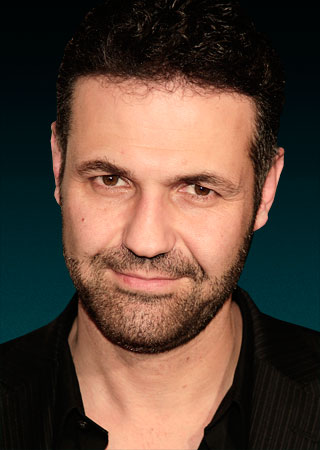 His talk was about his journey toward becoming a writer. He said it was never a "choice" for him, like Jessica Rabbit, "It's how he was drawn."
Hosseini told us the story of his family's move from his happy childhood home in Kabul to Paris in 1976 for his dad's work and finally to San Jose, CA in 1980, because to return to Kabul meant certain death for his father and possibly all of them-- he told us California stories about the things his parents did to provide for them.
He told us specifically about the five steps he took to becoming a writer which included things like learning English in grade 9, working a variety of jobs, one of which was a security guard that had cameras on him so he couldn't do much other than sit... no reading etc. But he could write and write he did. Finally he became a doctor.
In the spring of 1999 he heard that kite flying, a central image from his childhood, was banned in Afghanistan and it prompted him to write a short story which he expected would be a pleasant story of kite flying. What emerged was a short story of betrayal, loss, friendship and forgiveness.
In March of 2001, he finally finished an expanded version of the short story. This was the novel The Kite Runner. Refused to believe he was a "success" until he heard a question about his book on Jeopardy. If Alex Trebek says so, I guess I am was his rationale!
He never claimed to be an expert on Afganistan and really felt inadequate when people would ask him to be such. Yet, in response to that expectation he's begun to learn. He shared with us the state of things in Afghanistan today and went on to explain where things went wrong. This was all very interesting and could probably be an entirely separate blog post. In September of 2007 he took a trip to Afghanistan and it was a life altering experience for Hossieni and it prompted him to create a foundation to fund projects for Afghan women and children which partners with the UN refugee organization HCR.
His bottom line in his talk: Apathy is the most dangerous thing in our world today. We've become lulled in our self-centered lives of comfort and we do nothing. Though that might seem cynical, the reality is so many of us realize suffering is inevitable and pervasive. Thus we are defeated and overwhelmed by it. We become fatalistic. But we are not helpless and we need to break the shackles of apathy. He doesn't want his kids to have an insular existence--he wants them to understand the world has suffering, but that we are NOT helpless and we can always DO something. It was an inspiring talk.
I'll try to do a few posts on my favorite bits:
The Khaled Hosseini portion of the opening session.
His talk was about his journey toward becoming a writer. He said it was never a "choice" for him, like Jessica Rabbit, "It's how he was drawn."Hosseini told us the story of his family's move from his happy childhood home in Kabul to Paris in 1976 for his dad's work and finally to San Jose, CA in 1980, because to return to Kabul meant certain death for his father and possibly all of them-- he told us California stories about the things his parents did to provide for them.
He told us specifically about the five steps he took to becoming a writer which included things like learning English in grade 9, working a variety of jobs, one of which was a security guard that had cameras on him so he couldn't do much other than sit... no reading etc. But he could write and write he did. Finally he became a doctor.
In the spring of 1999 he heard that kite flying, a central image from his childhood, was banned in Afghanistan and it prompted him to write a short story which he expected would be a pleasant story of kite flying. What emerged was a short story of betrayal, loss, friendship and forgiveness.
In March of 2001, he finally finished an expanded version of the short story. This was the novel The Kite Runner. Refused to believe he was a "success" until he heard a question about his book on Jeopardy. If Alex Trebek says so, I guess I am was his rationale!
He never claimed to be an expert on Afganistan and really felt inadequate when people would ask him to be such. Yet, in response to that expectation he's begun to learn. He shared with us the state of things in Afghanistan today and went on to explain where things went wrong. This was all very interesting and could probably be an entirely separate blog post. In September of 2007 he took a trip to Afghanistan and it was a life altering experience for Hossieni and it prompted him to create a foundation to fund projects for Afghan women and children which partners with the UN refugee organization HCR.
His bottom line in his talk: Apathy is the most dangerous thing in our world today. We've become lulled in our self-centered lives of comfort and we do nothing. Though that might seem cynical, the reality is so many of us realize suffering is inevitable and pervasive. Thus we are defeated and overwhelmed by it. We become fatalistic. But we are not helpless and we need to break the shackles of apathy. He doesn't want his kids to have an insular existence--he wants them to understand the world has suffering, but that we are NOT helpless and we can always DO something. It was an inspiring talk.
Subscribe to:
Posts (Atom)
LinkWithin
